



Our team builds every watch that leaves our bench, and we've had enough conversations with customers to know that most watch problems aren't manufacturing defects, they're just a lack of basic care. None of this is complicated. Here's everything we tell people when their watch arrives.
Winding your automatic watch
An automatic watch winds itself through the natural motion of your wrist as you wear it. If you wear it daily, you'll rarely need to think about winding at all. Problems show up when a watch sits unworn for a few days and the power reserve runs down.
If your watch has stopped because it's been sitting still, give it a manual wind before putting it back on. Turn the crown clockwise 20 to 30 times if it's in the winding position. This gets enough tension in the mainspring for the automatic rotor to take over once it's back on your wrist. Movements like the NH35 and NH34 support hand-winding specifically for this reason.
Avoid over-winding by force. A mechanical mainspring has a natural stopping point, and you shouldn't feel like you need to force the crown past resistance.
Setting the time correctly
Most of our builds use movements with hacking seconds, meaning the second hand stops when you pull the crown out to set the time. This makes it easy to set the time precisely against a reference clock. One thing to avoid: don't set the date between roughly 9pm and 3am. The date-change gear is engaging during that window, and forcing it can damage the mechanism. If you need to set the date during that period, move the hour hand forward past midnight first, then set the date.
Storage
If you're not wearing your watch for an extended period, store it somewhere dry, away from direct sunlight, and ideally in the box or a soft pouch that keeps dust off the crystal and case. Extreme temperature swings aren't good for the lubricants inside a mechanical movement, so avoid leaving it in a hot car or near a radiator.
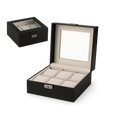
If you own more than one automatic watch and rotate between them, a basic watch storage case is worth the investment. It keeps straps from creasing and cases from knocking against each other in a drawer.
Water exposure
Most of our automatic builds carry solid water resistance for daily wear, splashes, and handwashing, but we'd still avoid hot showers or swimming unless the specific model's listing confirms it's rated for that. Heat can affect the gaskets that keep water out over time, and a quick rinse under cool water after exposure to salt water or chlorine is a good habit if you do wear it swimming.
Cleaning
A soft microfiber cloth is all you need for the case and crystal most of the time. For the bracelet or areas that pick up dirt, a soft-bristled brush (an old, clean toothbrush works fine) with a little mild soap and water gets into the links without damaging anything. Dry thoroughly afterward, especially around the crown and case back.
If your watch has a sapphire crystal, you can clean it a bit more confidently since it resists scratching so well. We explain why that matters more broadly in our piece on sapphire crystal vs mineral glass.
Service intervals
Mechanical movements use tiny amounts of lubricant that dry out and thicken over years of use. As a general guideline, a full service every 3 to 5 years keeps a movement like the NH35 or NH34 running accurately and protects it from wear that's harder to fix later. You don't need to send it back to us for this. Any competent local watchmaker familiar with Seiko-based movements, which is most of them, can service these calibers.
What's covered under warranty
Every watch we build comes with a 1 year warranty covering manufacturing defects, and we stand behind that because we built the watch ourselves and know exactly what went into it. If something goes wrong that isn't due to accidental damage or water exposure beyond the watch's rating, reach out and we'll sort it out. You've also got 14 days to return a watch if it's simply not right for you.
The bottom line
An automatic watch rewards a little bit of basic care with decades of reliable use. Wind it when it needs it, keep it away from extreme heat and unnecessary water exposure, clean it gently, and get it serviced every few years. Do that and the watch you buy today should still be running well long after you've stopped thinking about it day to day.
If you're shopping for your first (or fifth) piece, take a look at the full collection and our straps and accessories. Every build ships with the same 1 year warranty and the same care we've described here.